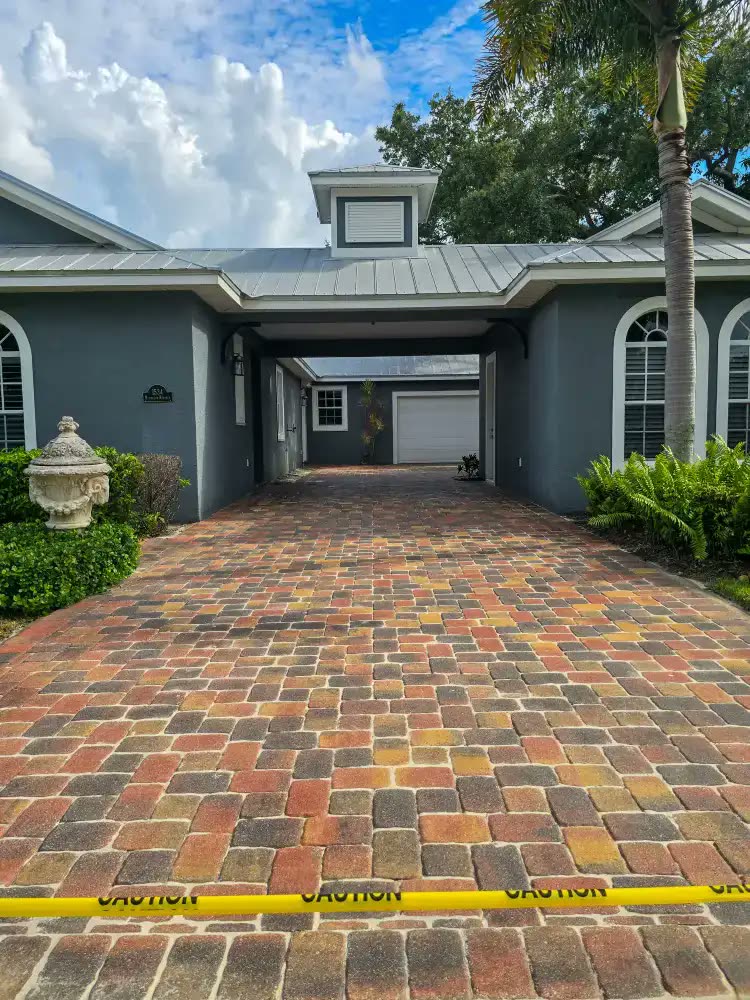
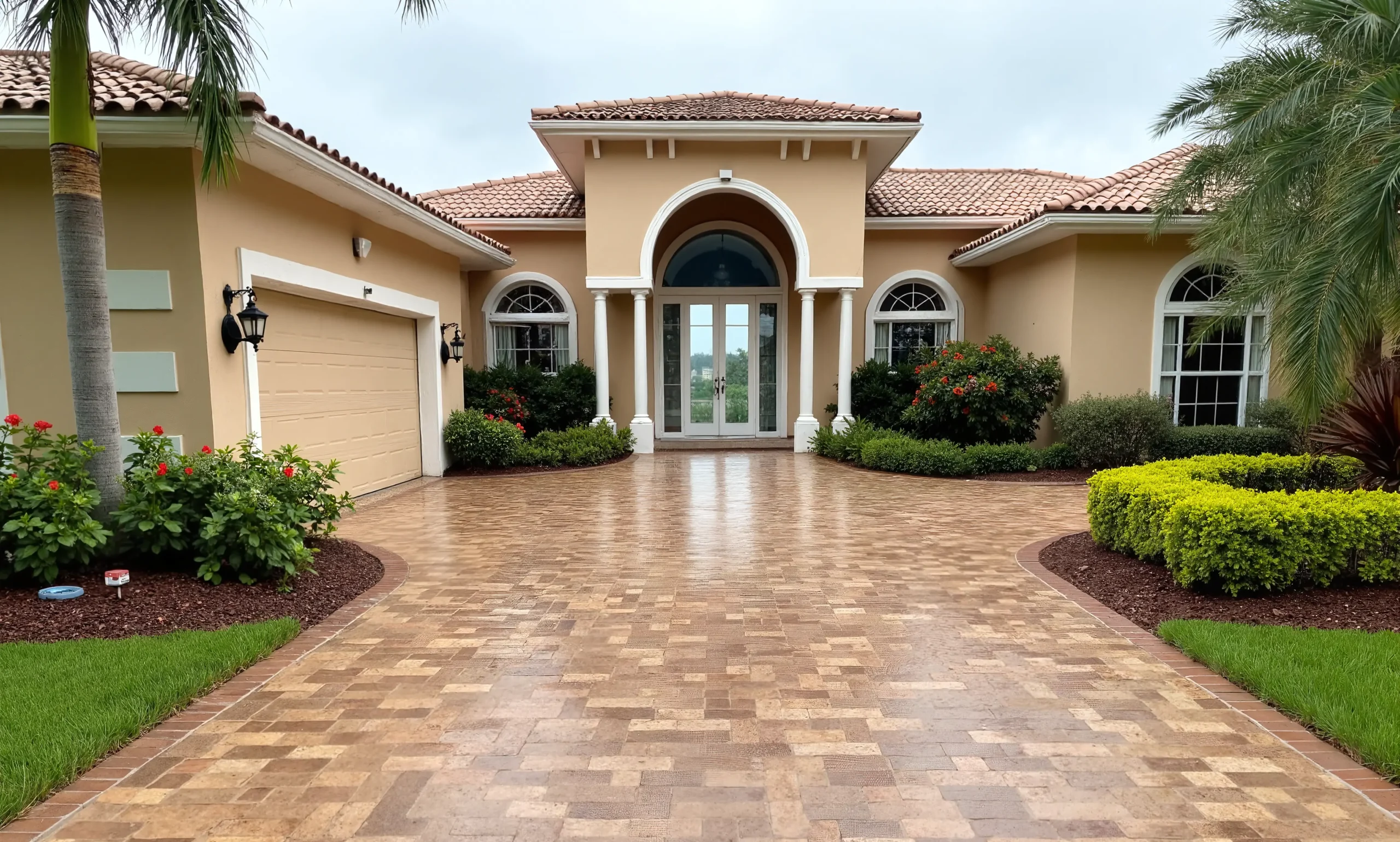
It usually announces itself through your feet. A paver near the pool rocks slightly when you step on it. A few weeks later there is a visible dip where there used to be a flat deck, and after rain, a puddle marks the spot like a flag. Sunken pavers around a pool are the most common paver problem in Southwest Florida — and one of the most misunderstood, because the pavers themselves are almost never the problem. The ground under them is.
Why pool deck pavers sink here
A paver surface is only as stable as its bedding — the compacted layer of sand the pavers sit on. Around Florida pools, three forces attack that layer constantly:
Water washing out the base. This is the big one. Pool splash-out, rain runoff, and — very often — a clogged deck drain send water under the pavers instead of away from the deck. Each soaking carries a little bedding sand with it as it drains through the fill. The process is invisible for years: the sand leaves grain by grain, a void forms, and the pavers above it hold together by friction until one day they do not. The reason the dip so often appears near the coping — the stone border where deck meets pool — is that this is exactly where splash-out concentrates and where the deck's construction joint gives migrating sand somewhere to go.
Settling fill. Most Southwest Florida pool decks are built over the sandy fill that was placed when the pool was dug. Fill compacts over time, especially in the first decade, and it compacts unevenly — which is why a deck can sink in one quadrant while the rest stays true.
Tree roots. The reverse problem: instead of sinking, a run of pavers lifts and tilts as a root thickens underneath. In this region it is usually a live oak or a ficus, and it shows up on walkways and driveways more than pool decks — a ridge line of raised pavers tracing the root's path.
The fixes that do not work
Two popular shortcuts make the problem worse. Hammering the high edges down with a mallet closes the visible lip but does nothing about the void below — the paver now sits lower and unsupported, and the dip returns deeper after the next rainy season. Topping up the joints with sand hides the gaps for a season while the base keeps eroding underneath. Both treat the symptom you can see and ignore the cavity you cannot.
What a real repair looks like
A proper paver repair is base work. The affected pavers are lifted and set aside in their pattern. The failed bedding is rebuilt — washed-out sand replaced, the base re-compacted and re-screeded to the correct slope, so water once again runs toward the drains instead of under the deck or against the house. The original pavers go back in, leveled flush with the surrounding field; any cracked ones are swapped for the spares most builders leave on the property. Finally the joints are refilled with polymeric sand, which hardens after activation and resists the washout that loosened the deck in the first place.
Done this way, the repaired section disappears into the deck — same pavers, same pattern, correct plane — and it stays put, because the thing that moved them has been addressed, not painted over. Most repairs finish with a full cleaning and sealing, which locks the fresh joint sand in place and brings the whole surface to one uniform finish, so the repair does not read as a patch.
Repair or replace?
Repair, in most cases. If the pavers are intact and the problem is local — a sunken area near the pool, one root-lifted run, joints gone soft — lifting and re-laying that section costs a fraction of replacement and is invisible when done right. Replacement earns its price only when pavers are cracked across large areas, the base has failed everywhere at once, or a discontinued product makes matching impossible even from hidden borrow areas. An honest contractor will tell you which side of the line your deck is on at the estimate — and should be able to explain why the deck moved, not just quote putting it back.
When to worry — and when to simply schedule it
Worry is the wrong frame for most sunken pavers; timing is the right one. A small dip away from the pool can wait for a convenient season. Three situations deserve faster attention: movement at the coping line, because voids there can undermine the deck's edge support; a dip that doubles after a single rainy season, because fast growth means active washout, usually from a drain or downspout problem that is still running; and rocking pavers in a walking path, which are a trip hazard on a surface people cross barefoot and wet.
And whatever the timing, pair the repair with the cause. If water put the void there — and around pools it almost always did — make sure the deck drains actually flow and the downspouts discharge where they should. Re-leveling a deck while the water that sank it keeps arriving is an appointment to do it all again.