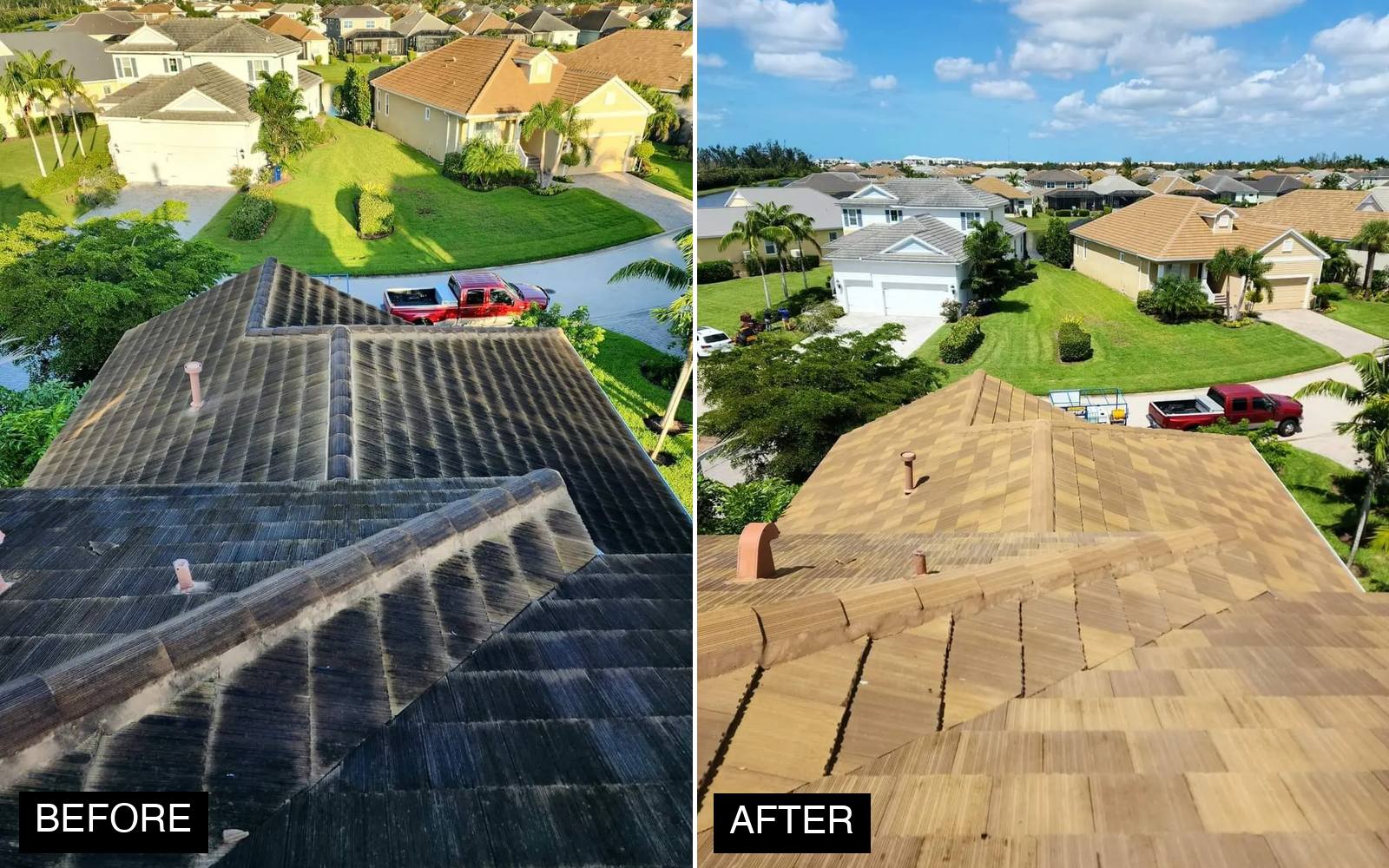

Sooner or later every Southwest Florida homeowner with a tile roof hears the word "restoration." It shows up in door hangers, in quotes from roofers, and in conversations with neighbors whose roofs suddenly look new again. It often gets used interchangeably with roof cleaning — and that confusion costs people money in both directions. Some pay for a full restoration when the roof only needed cleaning; others pay for a cleaning when the roof actually needed repairs. This guide explains what each service is, what each one fixes, and how to tell which one your roof needs.
The short answer
Roof cleaning removes what is growing on the roof: the black streaks of Gloeocapsa magma algae, mold, mildew, lichen, and the dirt they trap. Done properly with a soft wash, it restores the roof's appearance and stops the growth from shortening the life of the tiles or shingles. It does not repair anything.
Roof restoration is a bundle of services aimed at extending the life of an aging roof without replacing it. It normally starts with a cleaning, then adds repairs — replacing cracked or broken tiles, re-securing loose ones, re-bedding or re-pointing ridge and hip caps, resealing flashing and penetrations — and often finishes with a sealer or coating over the tiles.
In other words: every restoration includes a cleaning, but a cleaning is not a restoration. The question is whether your roof has a growth problem, a repair problem, or both.
Side by side
| Roof cleaning | Roof restoration | |
|---|---|---|
| What it fixes | Algae, mold, mildew, lichen, black streaks, dirt | Growth plus broken tiles, loose ridge caps, worn sealant and flashing, faded finish |
| Who does it | Soft wash exterior cleaning companies | Roofing contractors or roof coating specialists (licensed for the repair work) |
| How long it takes | Usually a few hours, one visit | Several days, depending on repairs |
| Typical cost range | A fraction of restoration — cleaning is priced by roof size and pitch | Several times the cost of cleaning; varies widely with the repair scope |
| How often | Every few years, as growth returns | Once or twice in a roof's life |
| Affects underlayment? | No | No — restoration works on the tiles and trim, not the waterproof layer underneath |
What roof cleaning actually does for a Florida roof
The dark streaks on Southwest Florida roofs are a living organism, not dirt or shadow. The algae feeds on the limestone filler in shingles and the cement in concrete tiles, holds moisture against the surface, and absorbs heat. Left alone it opens the door to moss and lichen, which root into the surface and lift granules and tile edges — the kind of slow damage that shortens a roof's lifespan long before anything looks broken. A soft wash roof cleaning kills the growth with a low-pressure cleaning solution rather than blasting it off — high pressure would strip shingle granules and erode concrete tile.
Regular roof cleaning — typically every two to three years in our climate, as algae regrowth returns — keeps that damage from starting and brings back the curb appeal at the same time. When the tiles and trim are sound, cleaning is all the roof needs. That is the case for a large share of roofs in Lee and Collier County, including many older roofs that were simply never cleaned. A roof that looked "finished" because of the streaks often turns out to be in good shape once it is clean.
What is a full roof restoration?
A full roof restoration is a planned sequence of cleaning, roof repair, and protective treatment that brings an aging roof back to sound condition without replacing it. A restoration contractor typically:
- Cleans the roof — the same growth removal as a cleaning, because nothing can be repaired or sealed on a dirty surface.
- Inspects and repairs tiles — cracked, broken, or slipped tiles are replaced or re-secured. On concrete tile roofs, foot traffic from past repairs and storms is a common cause of hidden cracks.
- Repairs ridge and hip caps — the mortar or adhesive holding the caps can crack and let water and wind in.
- Reseals flashing and penetrations — around vents, skylights, chimneys, and walls.
- Applies a sealer or coating — on concrete tile, a clear sealer or a pigmented roof coating can refresh the color and slow water absorption. This step is optional and it is the one most worth asking questions about: some HOAs regulate roof colors, and a coating is a commitment to re-coating later.
Florida's "25% rule" and roof repairs
Homeowners researching restoration often run into the Florida "25% rule." Historically, the Florida Building Code required that if more than 25% of a roof section was repaired or replaced within a 12-month period, the whole section had to be brought up to current code — which could turn a big repair into a re-roof. A 2022 change relaxed this for roofs that were already built to the 2007 code or later: on those roofs, only the damaged portion needs to be repaired. Which side of that line your roof falls on depends on when and how it was installed, so a roofer's inspection and your insurer are the right sources for your specific case. Roof cleaning is not a repair and does not trigger the rule.
The part neither service touches: the underlayment
This is the most important point for tile roofs in Florida, and it is where "restoration" is sometimes oversold. On a tile roof, the tiles shed most of the water, but the real waterproofing is the underlayment — the membrane installed on the roof deck beneath the tiles. Concrete and clay tiles can last for many decades; underlayment wears out much sooner, typically in the range of twenty to thirty years depending on the product and installation.
Neither cleaning nor restoration replaces the underlayment. If it has failed — leaks inside the house, stained ceilings, soft spots in the deck — making the tiles look new does not fix the problem. The repair at that stage is a re-roof, in which the tiles are lifted, new underlayment is installed, and the tiles (often the same ones) are relaid. Any restoration quote on an older tile roof should say plainly what condition the underlayment is in.
Which one does your roof need?
| What you see | Most likely need |
|---|---|
| Black streaks, green or gray patches, otherwise intact tiles | Roof cleaning |
| HOA or insurance letter about roof appearance | Roof cleaning, with before-and-after documentation |
| A handful of cracked or slipped tiles, plus streaks | Cleaning plus a targeted tile repair by a roofer |
| Faded, chalky tiles across the whole roof, loose ridge caps, worn flashing | Restoration |
| Moss and lichen patches, no damage underneath | Roof cleaning with a moss and algae treatment |
| Leaks or ceiling stains, roof 20+ years old | Roof inspection for underlayment — possibly a re-roof |
Is roof restoration worth it?
It can be, when the roof's underlayment still has years left and the problems are on the surface — broken tiles, failing ridge caps, a faded finish. In that situation restoration buys time at a fraction of replacement cost. It is not worth it when the underlayment is near the end of its life, because the roof will need to come apart anyway, and money spent coating tiles that are about to be lifted is money lost.
And it is not worth paying for when the roof only needed cleaning. If the main complaint is how the roof looks, start with a cleaning, then judge what is left. For the cost side of that decision, see whether roof cleaning is worth it compared with replacement and what soft wash roof cleaning costs in Southwest Florida.
Where Rain Exterior Home Service fits
Rain Exterior Home Service is a roof cleaning company, not a roofing contractor. We soft wash tile, shingle, and metal roofs across Lee and Collier County, and we document every job with before-and-after photos. If we see cracked tiles, loose caps, or anything else that needs a roofer while we are on the roof, we tell you and point you toward the right specialist, so you know whether you are looking at a cleaning, a repair, or a bigger conversation.
See soft wash roof cleaning in Fort Myers, roof cleaning in Cape Coral, or the roof cleaning service overview for the process and areas served.