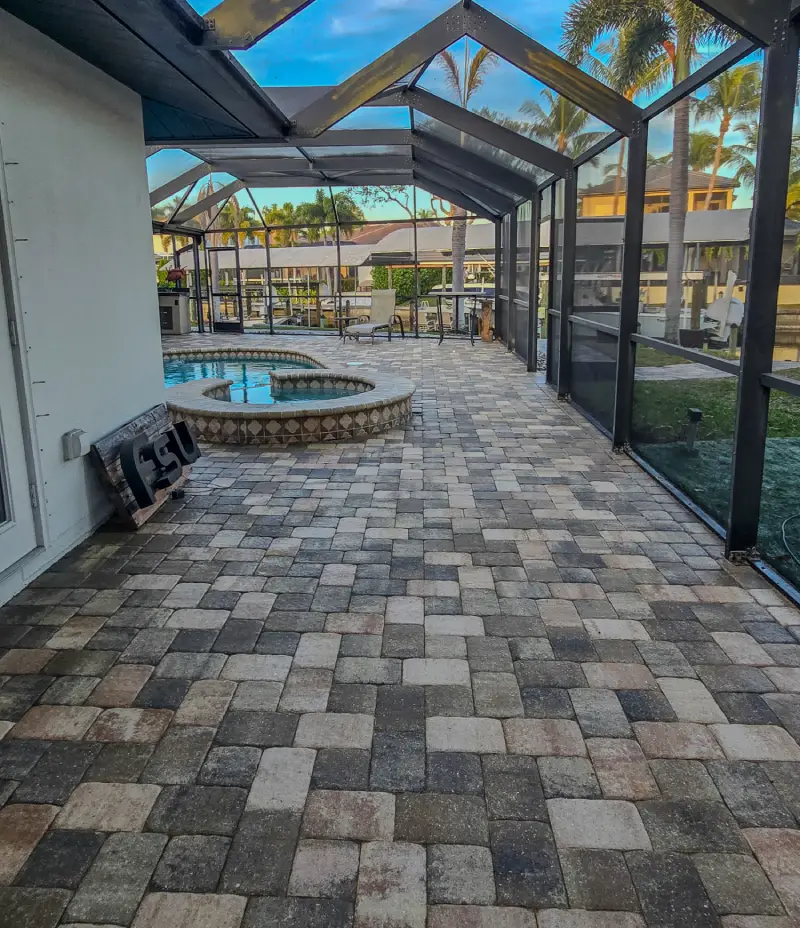
Travertine and marble are the reason so many Southwest Florida pool decks and lanais look like a resort. They are also the two surfaces on the property most likely to be damaged by well-meant care. Both are calcium-based stones, both are porous, and both react to the cleaners, sealers, and pressure that concrete pavers shrug off. This guide covers what actually protects natural stone in our climate — how to clean it, when and how to seal it, and the handful of mistakes that cause most of the problems we are called out to fix.
Why natural stone behaves differently from pavers
A concrete paver is a manufactured block with a fairly even, tight surface. Travertine is a limestone formed by mineral springs, full of small voids and channels; marble is limestone transformed by heat and pressure into a denser, crystalline stone. What they share is chemistry: both are mostly calcium carbonate. That single fact explains nearly every rule below.
- Acids dissolve them. Vinegar, citrus, many "rust removers," and the muriatic-acid washes used on concrete etch calcium carbonate on contact. On marble the damage shows up as dull, rough marks; on travertine it opens the pores and roughens the face.
- They drink water — and whatever is in it. Irrigation water with iron, pool water, leaf tannins, and sunscreen oil all wick into unsealed stone and stain from inside.
- They need to breathe. Moisture moves up through stone from the ground and the bedding below. Anything that seals that moisture in eventually fails.
Cleaning travertine and marble the right way
Low pressure, always. A high-pressure wand will cut into travertine, blow out the fill in its holes, and leave tracks on marble that never polish out. Natural stone is cleaned with soft wash technique: a stone-safe cleaning solution does the work, and the rinse is gentle. If someone arrives to clean your travertine deck with a turbo nozzle, stop the job.
pH-neutral cleaners only. For routine cleaning, use a cleaner labeled safe for natural stone. Skip vinegar, lemon, bleach-heavy mixes left to dwell, and any "all-surface" product that does not say stone-safe.
Treat mold and algae in the pits early. The open holes in travertine hold water and shade, which is exactly what algae wants. Dark specks that keep returning in the same spots are growth living in the voids, not dirt on the surface. Professional soft wash cleaning reaches into those pits without damaging the stone around them.
Rust and irrigation stains need a stone-specific treatment. Standard rust removers are acidic and will etch the stone while removing the stain. Rust on travertine and marble is treated with products formulated for calcium-based stone, and the irrigation head causing it should be redirected first — otherwise the stain is back in a month.
Saltwater pools and travertine
Saltwater pools are common across Lee and Collier County, and they are hard on porous stone. Splash-out soaks into the travertine; as the water evaporates in the sun, salt crystallizes inside the pores. Each crystal grows a little, and over seasons the surface can begin to flake and pit — usually first along the coping and in the splash zone of the spillway. The defense is a good penetrating sealer kept in good condition, plus a regular freshwater rinse of the splash zone. A sealed deck sheds splash-out; an unsealed one absorbs it.
Sealing natural stone: penetrating, not film-forming
This is the single most important decision in natural stone care. There are two broad families of sealer:
- Penetrating (impregnating) sealers soak into the stone and line the pores, so water and stains bead up instead of soaking in. Nothing sits on the surface, the stone keeps its natural texture and grip, and moisture from below can still escape.
- Film-forming (topical) sealers leave a coating on top — the glossy "wet look" that works well on many concrete pavers.
On travertine and marble, film-forming sealers are the most common cause of failure we see. The finish looks spectacular for a few months; then the moisture the stone naturally releases gets trapped under the film, and the deck turns cloudy white — almost always first around the pool coping and on the shaded side, where the stone stays wet longest. The film also makes a pool deck slick underfoot. Fixing it means stripping the coating off the stone, which is slow, careful work.
Natural stone takes a penetrating sealer. If you want the stone's color deeper and richer, there are color-enhancing penetrating sealers that darken the tone slightly while still protecting from within — the look changes, the stone still breathes.
How often to reseal
In our sun and rain, plan on resealing exterior travertine and marble roughly every two to three years, sooner on pool decks with heavy splash-out. The stone tells you when: sprinkle a little water on a few spots — especially near the pool and under the downspouts. If it beads, the sealer is still working. If it darkens the stone and soaks in within a minute or so, it is time.
What a proper sealing job includes
- Identify the stone and any previous sealer. A failed film sealer has to come off before anything new goes on.
- Soft wash cleaning with stone-safe products, including treatment of algae in the pits and any rust staining.
- Full drying — typically 24 to 48 hours, scheduled around the forecast. Sealing damp stone traps moisture and causes haze.
- Penetrating sealer applied in the right number of coats for how porous the stone is, with excess removed so nothing films on the surface.
Filled vs. unfilled travertine
Many pool-deck travertine pavers come "filled," with the factory holes packed with a cementitious filler, and some are left "unfilled" or "tumbled" with the voids open. Over time, filler in the sun-exposed areas can loosen and pop out, opening new holes. That is normal aging, not a defect, but it changes how the stone should be cleaned (gently, to avoid blasting out more fill) and how much sealer it absorbs. A careful look at the deck before quoting sorts this out.
Marble outdoors: extra care
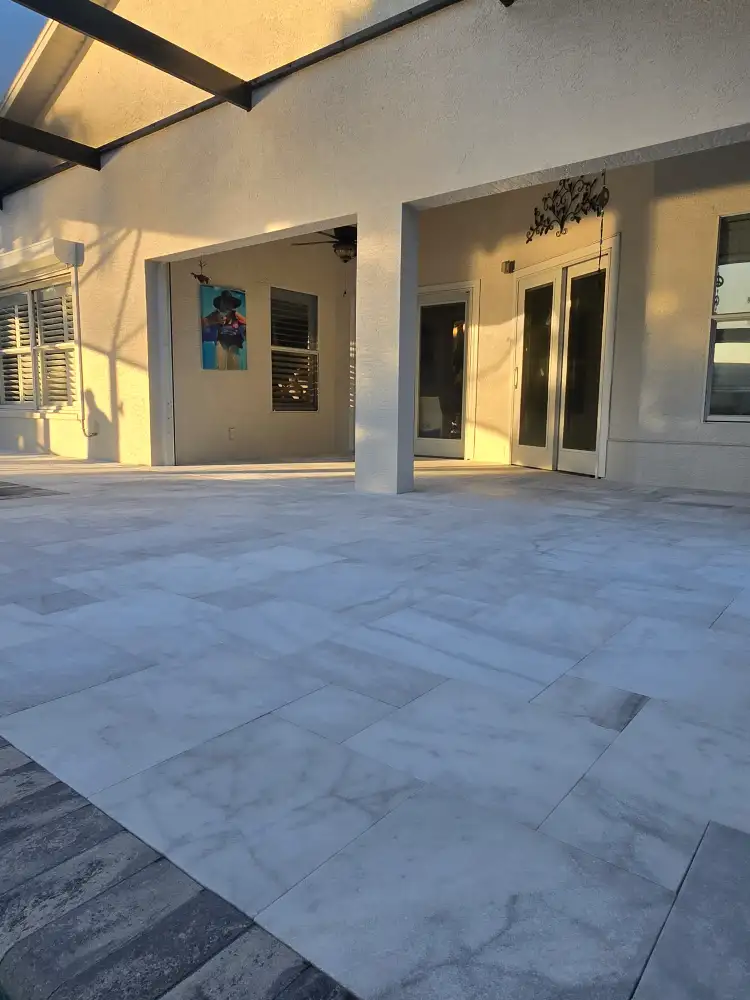
Marble shows up on lanai floors, entry steps, and outdoor kitchens in higher-end homes, including a marble sealing project completed in Estero. It is less porous than travertine but more sensitive to etching — a spilled margarita leaves a dull mark the sealer cannot prevent, because sealers block absorption, not acid reactions. Wipe acidic spills quickly, use coasters and trays in outdoor kitchens, and keep marble on the same penetrating-sealer and soft-wash routine as travertine.
Quick reference: do and don't
| Do | Don't |
|---|---|
| Soft wash with stone-safe cleaners | Use a high-pressure wand or turbo nozzle |
| Seal with a penetrating sealer | Apply a glossy film-forming sealer |
| Water-test the sealer every season | Wait until stains appear to reseal |
| Rinse saltwater splash zones with fresh water | Let pool salt dry in the pores week after week |
| Fix irrigation that sprays the stone | Use acidic rust removers on travertine or marble |
Getting it done
Rain Exterior Home Service cleans and seals travertine and marble across Southwest Florida, with much of that work on pool decks and lanais in Naples. If you are not sure which stone you have, or whether an old sealer has failed, a single clear daylight photo of the surface is usually enough to tell. See how travertine and marble sealing in Naples works, including pricing and the neighborhoods served, or read about pool deck cleaning and the full paver and stone sealing service. In Lee County, the same process applies to paver and stone sealing in Fort Myers. If your surface turns out to be concrete or clay brick pavers instead, see how to choose a brick paver sealer and sealing company.