
Concrete and clay tile roofs soft washed at garden-hose pressure — black streaks, lichen, and moss killed at the root, with no pressure washer on the tile.
Tile is the roof Southwest Florida is known for, and it is also the roof that shows algae the most. The same barrel tile that looks terracotta from the street on a new home is streaked black within a few years, because concrete roof tiles are porous and stay damp long after the rain stops. In this climate that is all roof algae needs.
Rain Exterior Home Service cleans tile roofs with a soft wash process only. A biodegradable cleaning solution is applied at low pressure, left to dwell, and rinsed away, taking the black algae, mildew, lichen, and moss with it. No pressure washer touches a tile roof on our jobs: pressure cracks and dislodges tiles, drives water underneath them, and strips the surface that gives the tile its color.
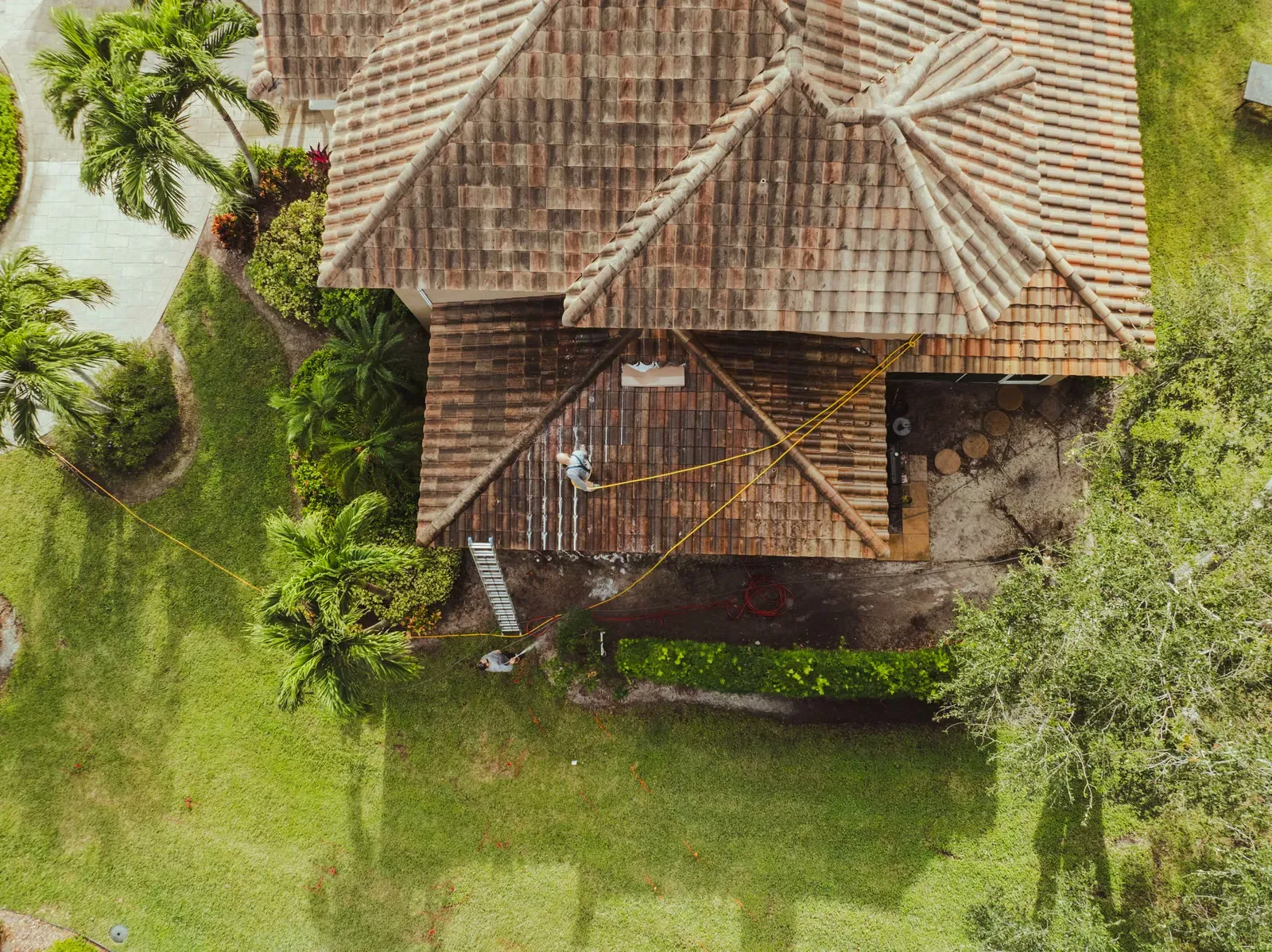
The roof in the photo above is a barrel tile roof we cleaned in Fort Myers, photographed by drone the same day. Before the cleaning the whole surface was dark with algae and mildew; afterward the tile was back to its original color. A soft-washed roof here typically stays clean for two to four years, because the growth is killed in the tile rather than rinsed off the top.
We clean concrete tile, clay barrel tile, and flat tile roofs throughout Fort Myers, Cape Coral, Naples, Estero, Bonita Springs, and the rest of Lee and Collier County. Homeowners, property managers, and HOA communities all get the same thing: free estimates on-site or from photos, and the exact price before any work begins. For shingle and metal roofs, see our main soft wash roof cleaning page.
On a shingle roof, the shingle is the waterproofing. On a tile roof it is not: the tile sheds most of the water and takes the sun, and the underlayment beneath it is what actually keeps the house dry. That changes what a careless cleaning can damage. A pressure washer on tile can crack tiles, break the mortar or foam that holds the ridge caps, and drive water up under the laps onto an underlayment that was never meant to be hit from that direction.
The tile surface matters too. Most roofs in Lee and Collier County are concrete tile, which is porous and carries its color in a thin coat on the surface. Algae roots in those pores, and high pressure removes the color coat along with the algae — which is why a pressure-washed concrete tile roof often looks pale and patchy a year later, and grows back faster than before.
| Roof tile | How to recognize it | What to know before cleaning |
|---|---|---|
| Concrete tile — barrel or S profile | The rolled, wave-shaped tile on most Southwest Florida homes built since the 1990s | Porous, holds moisture, grows black algae quickly. Color coat is on the surface, so low pressure only. |
| Concrete tile — flat profile | Flat, slate-like or shake-like tiles laid in straight courses | Same material as above. Debris and moss collect in the joints between tiles and along the valleys. |
| Clay barrel tile | Two-piece Spanish or mission tile, terracotta color through the whole tile | Less porous and does not fade, but more brittle under foot. Lichen is the usual problem. |
The dark streaks that run down from the ridge are a living growth called Gloeocapsa magma — usually just called black algae or roof algae. Its spores travel on the wind from roof to roof, which is why a whole street tends to streak at the same pace. Lichen and moss follow in the shaded and north-facing sections, and they are harder on the roof: they hold moisture against the tile and grip the surface. A soft wash kills all of them. The algae and mildew are gone when the roof is rinsed; dead lichen and moss turn pale and let go over the following weeks as rain washes the roof, because scraping them off would take the tile surface with them.
For most single-story homes in Lee and Collier County, soft wash roof cleaning runs from $350 to $800. Where a tile roof falls in that range depends on its size, how steep it is, how many sections and valleys it has, and how heavy the growth is. Two-story homes and large roofs cost more. The price is given exactly, in writing, before any work begins — see the Southwest Florida roof cleaning price guide for how the numbers are worked out.
Cleaning removes what is growing on the tile. It does not repair cracked or slipped tiles, re-set loose ridge caps, or bring back a color coat that the sun has worn thin over twenty years — and it will not stop a leak, because a leak on a tile roof is an underlayment problem. We are a cleaning company, not a roofer: we show you what we find, with photos, and you decide what to do with it. If you are trying to work out whether your roof needs a cleaning, a coating, or a roofer, this guide to roof cleaning versus roof restoration lays out the difference.
Tile roofs are the standard in most gated communities here, and a streaked roof is one of the most common reasons for an HOA exterior notice. There is a second reason homeowners call: Florida insurers increasingly review roofs from aerial photos at renewal, and a roof covered in black streaks can read as a worn roof from above (see what to do with a roof letter from your insurer). Cleaning does not make an old roof new, but it does make sure the roof is judged on its condition and not on its algae.
How It Works
Before any solution goes on, we look at the roof from the ground and from above: concrete or clay tile, the condition of the ridge and hip caps, and any tile that is already cracked, slipped, or broken. Existing damage is photographed and shown to you before cleaning starts.
Landscaping under the roofline is soaked with fresh water, the gutters and downspouts are checked so the rinse has somewhere to go, and air conditioning units and pool cages below the eaves are accounted for in how the roof is rinsed.
A biodegradable cleaning solution is applied at low pressure — about what a garden hose delivers — and left to dwell for 15 to 30 minutes. It soaks into the porous surface of the tile and kills the algae, mildew, lichen, and moss down to the root instead of shearing off the top.
The roof is rinsed at low pressure, the plants below are flushed with fresh water a second time, and the gutters are cleared of whatever came down. You get before-and-after photos of the roof with the job.
Common Questions
A low-pressure soft wash. A cleaning solution is applied at roughly garden-hose pressure, left to dwell so it kills the algae, mildew, lichen, and moss in the pores of the tile, and then rinsed off. We use it on every tile roof for one reason: the growth is killed instead of blasted, and the tile, the ridge caps, and the underlayment are left alone.
It can be done, and it is how many tile roofs get damaged. High pressure cracks tiles, breaks the mortar at ridge and hip caps, strips the color coat from concrete tile, and pushes water up under the laps to the underlayment. It also leaves the roots of the algae alive in the tile, so the streaks come back within months. We do not use pressure washers on tile roofs.
Most single-story homes in Lee and Collier County fall between $350 and $800 for a soft wash roof cleaning, depending on roof size, pitch, the number of sections and valleys, and how heavy the growth is. Two-story homes and larger roofs are higher. You get an exact written price before any work starts.
Every two to three years for most tile roofs in Southwest Florida. Roofs under heavy tree cover, next to a canal or lake, or with large north-facing sections may need it every year, because shade and moisture are what the algae needs. A good trigger is the first visible streaks below the ridge — cleaning at that stage is quicker and gentler than waiting until the whole roof is black.
It takes experience. Roof tiles break when weight lands in the wrong place — the unsupported middle of a tile — and hold when it lands on the lower edge, where each tile rests on the one beneath it. A cracked tile is the most common damage left behind by inexperienced cleaners. We keep foot traffic to what the job needs, and we check for cracked and slipped tiles before and after the cleaning.
If the color is hidden under algae, yes — the difference is usually dramatic, and the original terracotta, tan, or grey shows as soon as the roof is rinsed. If the color coat itself has worn away from sun and age, cleaning will show the roof as it really is: clean, but faded. We can tell you which one to expect before we start.
They die during the treatment, but they do not all rinse off the same day. Dead lichen turns white and dead moss turns brown, and both release from the tile over the following weeks as rain washes the roof. Scraping or blasting them off right away would take the surface of the tile with them, so they are left to let go on their own.
Plants under the roofline are soaked with fresh water before the treatment and flushed again after the rinse, which dilutes anything that reaches them. The gutters are checked first so the runoff drains away instead of overflowing onto beds, and cleared afterward. If you have delicate plants or a vegetable bed under an eave, point it out and we will cover it.
No. We clean roofs; replacing tiles and re-setting ridge caps is a roofer’s job. What we do is tell you exactly what we see while we are up there — with photos — so that if a roofer is needed, you already know where to send them.
What Homeowners Say
"Rain Exterior Home Center made my roof, home and driveway look brand new! Randy was thorough, professional, and a pleasure to work with! Thanks! You have a forever customer!"
"Exceptional service. Randall and his team arrived on time as scheduled, washed the entire exterior, windows, roof and walk ways. Left the home better than when we first moved in. Highly recommend this company!"
"Showed up on time and provided professional service at a reasonable cost!"
Serving Fort Myers, Cape Coral, Naples, Bonita Springs, and all of Southwest Florida. Most jobs quoted within 24 hours.

Rain Exterior Home Service
We Regularly Serve Homeowners in Southwest Florida:
